-
Good Urbanism
We all have a natural nesting instinct—we know what makes a good place. And a consensus has developed among urban planners and designers about the essential components of healthy, prosperous communities. So why aren’t these ideals being put into practice?In Good Urbanism, Nan Ellin identifies the obstacles to creating thriving environments, and presents a six-step process to overcome them: prospect, polish, propose, prototype, promote, present. She argues that we need to reach beyond conventional planning to cultivate good ideas and leverage the resources to realize them.
Ellin illustrates the process with ten exemplary projects, from Envision Utah to Open Space Seattle. Each case study shows how to pair vision with practicality, drawing on our best natural instincts and new planning tools.
For planners, urban designers, community developers, and students of these fields, Ellin’s innovative approach offers an inspired, yet concrete path to building good places.
-
Integral Urbanism
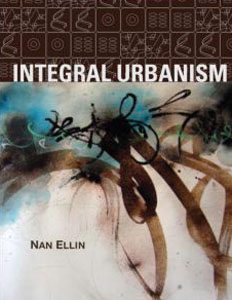
Integral Urbanism is an ambitious and forward-looking theory of urbanism that offers a new model of urban life. Nan Ellin’s model stands as an antidote to the pervasive problems engendered by modern and postmodern urban planning and architecture: sprawl, anomie, a pervasive culture – and architecture – of fear in cities, and a disregard for environmental issues. Instead of the reactive and escapist tendencies characterizing so much contemporary urban development, Ellin champions an ‘integral’ approach that reverses the fragmentation of our landscapes and lives through proactive design solutions.Integral Urbanism
Integral Urbanism is an ambitious and forward-looking theory of urbanism that offers a new model of urban life. Nan Ellin’s model stands as an antidote to the pervasive problems engendered by modern and postmodern urban planning and architecture: sprawl, anomie, a pervasive culture – and architecture – of fear in cities, and a disregard for environmental issues. Instead of the reactive and escapist tendencies characterizing so much contemporary urban development, Ellin champions an ‘integral’ approach that reverses the fragmentation of our landscapes and lives through proactive design solutions. -
Phoenix: 21st Century City
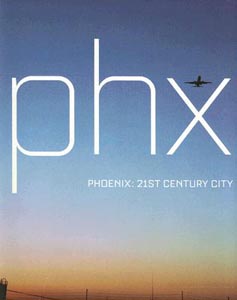
After Berlin, Brooklyn, and Moscow, Phoenix is the ideal fourth city to be explored in Booth-Clibborn Editionss fascinating series about cities that are emerging creatively. Thanks to its majestic desert setting, appealing climate, and abundant economic opportunity, the Phoenix metropolitan area is the fastest growing in the U.S. Along with its population growth, the city has seen a flourishing of expressive arts of all kinds. Phoenix 21: Desert Metropolis captures the historic movement and youthful energy of the region as it evolves into a vibrant world-class metropolis with a unique character.Phoenix: 21st Century City
After Berlin, Brooklyn, and Moscow, Phoenix is the ideal fourth city to be explored in Booth-Clibborn Editionss fascinating series about cities that are emerging creatively. Thanks to its majestic desert setting, appealing climate, and abundant economic opportunity, the Phoenix metropolitan area is the fastest growing in the U.S. Along with its population growth, the city has seen a flourishing of expressive arts of all kinds. Phoenix 21: Desert Metropolis captures the historic movement and youthful energy of the region as it evolves into a vibrant world-class metropolis with a unique character. -
Architecture of Fear
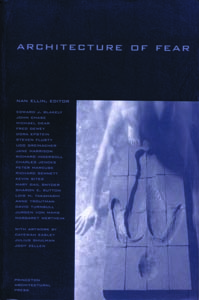
Architecture of Fear examines the ways in which the contemporary landscape is shaped by our society’s preoccupation with fear, as apparent in home design, security systems, gated communities, semi-public spaces (shopping malls, theme parks, casinos, office atriums), zoning regulations, and cyberspace. This fixation also manifests itself in efforts to provide public parks but control the problem of homelessness. The essayists in Architecture of Fear explain that such disjointed efforts exacerbate rather than eradicate the sources and perception of fear and insecurity. Thus, in contrast to alarmist, apocalyptic treatments, the contributors offer concrete, level-headed suggestions for proaction, not reaction, to counter both real (actual crime) and perceived (media-magnified) problems in contemporary society.
Contributors: Edward J. Blakely and Mary Gail Snyder, John Chase, Michael Dear and Jurgen von Mahs, Fred Dewey, Nan Ellin, Dora Epstein, Steven Flusty, Udo Greinacher, Jane Harrison, Richard Ingersoll, Charles Jencks, Peter Marcuse, Kevin Sites, Sharon Sutton, Lois Takahashi, Anne Troutman, David Turnbull, Margaret Wertheim, Richard Sennett, and Julius Shulman approach the topic of architecture and fear from a variety of angles: ‘Building Paranoia,” Addressing Fear through Community Empowerment,” Cyburbanism as a Way of Life,’ and ‘Walls of Fear and Walls of Support,’ to name just a few.
-
Postmodern Urbanism
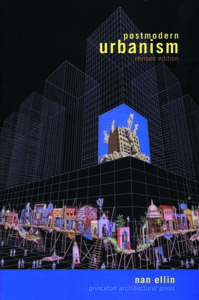
Since the 1960s, many architects and urban planners have reacted against the drab universalism and inhuman scale of modern architecture and urbanism, seeking instead to recover a sense of community and place. It is apparent to these architects and planners, as well as segments of the general public, that something needs to be done to improve the physical landscape and the sense of desolation it arouses. Efforts to do so have been grouped under the rubric “postmodern urbanism.” While this late- twentieth-century quest for meaning has elicited nostalgia for cities of the past, it has not been accompanied by a desire to relinquish technological innovations that raise the standard of living, or the pursuit of progress and modernity. Postmodern Urbanism examines these important and complex issues that directly affect our cities and neighborhoods in a book that has been widely heralded for its clarity and insight.Postmodern Urbanism
Since the 1960s, many architects and urban planners have reacted against the drab universalism and inhuman scale of modern architecture and urbanism, seeking instead to recover a sense of community and place. It is apparent to these architects and planners, as well as segments of the general public, that something needs to be done to improve the physical landscape and the sense of desolation it arouses. Efforts to do so have been grouped under the rubric “postmodern urbanism.” While this late- twentieth-century quest for meaning has elicited nostalgia for cities of the past, it has not been accompanied by a desire to relinquish technological innovations that raise the standard of living, or the pursuit of progress and modernity. Postmodern Urbanism examines these important and complex issues that directly affect our cities and neighborhoods in a book that has been widely heralded for its clarity and insight.